Nicolosi · 900 m37° 37′ N · 15° 01′ E
23 March – 18 April 1910
Etna, the 1910 lava flow
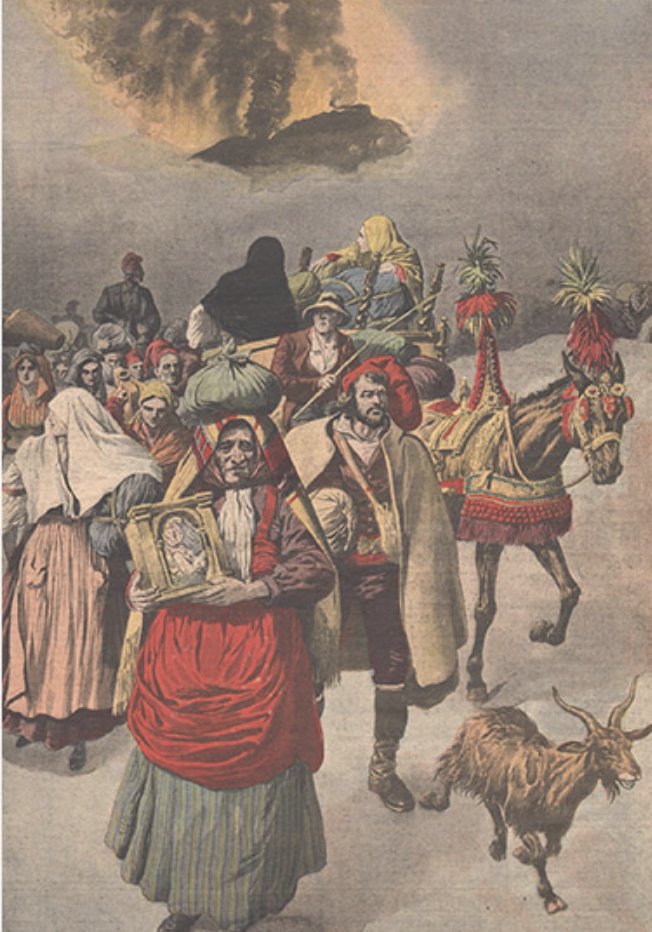
At 8.15 a.m. on 23 March 1910, there rose from the southern flank of Etna what Paolo Vinassa de Regny, a geologist at the University of Catania, described as ‘a mighty pine of smoke and steam’. He put its height at three thousand five hundred metres, before the clouds covered the mountain.

Eruzione dell'Etna – Fronte della lava in contrada Fra Diavolo

Eruzione dell'Etna – Lava in contrada Fra Diavolo

Eruzione dell'Etna – Avanzi della casa Gemmellaro
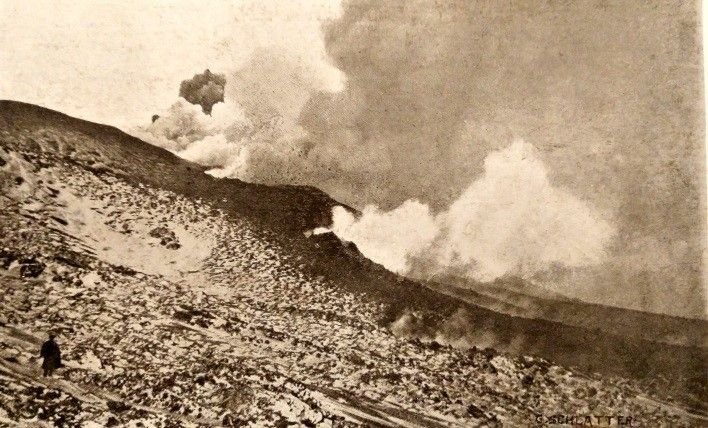
The stone comes from the La Rosa-Nocilla quarry, in Contrada Nocilla at Nicolosi, 900 metres up on the southern slope of Etna, where the 1910 flow comes to the surface. It is Etna basalt: grey, compact, with crystals of olivine, pyroxene and plagioclase set in a microcrystalline groundmass. The deposit contains no hazardous substances.
The stone chosen for Ara del Tempo comes from this flow. The origin of the batch is certified by the Consorzio della Pietra Lavica dell'Etna. Worked in Misterbianco (Catania) into the essential form of the sphere, it receives a few drops of extract on its surface and gives them back, little by little, to the air of a quiet room.
In 1910 it gave off heat. Today it gives back perfume.
The eruption opened near the Montagnola, during a seismic swarm. In less than a day the lava travelled almost eight kilometres towards Nicolosi and Belpasso; it stopped on 18 April in Contrada Cisterna della Regina, about a kilometre from Borrello, after more than ten kilometres. The cones born of that eruption were named the Monti Riccò, after the astronomer Annibale Riccò, director of the Catania Observatory.
The sphere comes with a 30% perfume extract in triethyl citrate of natural origin, a low-volatility carrier with no added ethanol.
Composition
Perfume extract: 30%. Odorous materials exclusively of natural origin, traced batch by batch. No synthetic aromatic molecules. Carrier: triethyl citrate of natural origin, low volatility, no added ethanol. Documentation of the raw materials in the Perfume Passport.
How to use it
- At the first application, place 10 drops directly on the sphere, leaving it on its base. Let the stone absorb them.
- When the note fades, revive it with 5 drops.
- The sphere is for DO · Neroli 2026 only. Do not wash it or use it with other fragrances.
- Always keep the sphere on its base, to protect furniture and surfaces from marks.
- With use, the stone may darken slightly: this is a natural result of contact with the extract.